Sunday, October 15, 2017

QUIZ - The Age Of Exploration

Print\Write the Questions and Correct Answers.
1. One of the main goals of European exploration was to:


    • A. 
      Form alliances
    • B. 
      End mercantilism
    • C. 
      Spread Christianity
    • D. 
      Find slaves
  • 2. 
    One reason Spain was able to defeat Native American empires was because of its
    • A. 
      Alliance with Montezuma
    • B. 
      Superior weapons
    • C. 
      Missionary work
    • D. 
      Superior numbers
  • 3. 
    The defeat of the Spanish Armada was important because
    • A. 
      Spain was unable to rebuild its navy
    • B. 
      Spain lost its colonial possessions
    • C. 
      The world saw that Spain could be beaten
    • D. 
      The English gained all of Spain's lands
  • 4. 
    Catholic _______________ converted many Native Americans, as well as people in China, Japan, and the Philippines.
    • A. 
      Explorers
    • B. 
      Missionaries
    • C. 
      Conquistadors
  • 5. 
    What were the Spanish explorers and soldiers who conquered territory in the Americas called?
    • A. 
      Pioneering
    • B. 
      Conquistadors
    • C. 
      Colonization
    • D. 
      Missionaries
  • 6. 
    Who was the Spanish conqueror of the Inca Empire in 1533?
    • A. 
      Francisco Pizarro
    • B. 
      Hernando Cortes
    • C. 
      Montezuma
  • 7. 
    Who was the first navigator to sail around the world?
    • A. 
      Amerigo Vespucci
    • B. 
      Christopher Columbus
    • C. 
      Ferdinand Magellan
  • 8. 
    This is a small, narrow ship with two or three masts and triangular sails.
    • A. 
      Caravel
    • B. 
      Sailboat
    • C. 
      Galleon
  • 9. 
    Who is the explorer from whom America got its name?
    • A. 
      Cabot
    • B. 
      Vespucci
    • C. 
      Da Gama
  • 10. 
    Who is the Italian explorer who claimed the West Indies for Spain?
    • A. 
      Christopher Columbus
    • B. 
      Panfilo Narvaez
    • C. 
      Hernando De Soto
  • 11. 
    Why did Atahualpa, the Incan emperor, order his troops not to fight?
    • A. 
      The Inca had enough gold and silver.
    • B. 
      The Inca feared the Spanish might be gods.
    • C. 
      They were hoping to trade with the Spaniards.
  • 12. 
    Aztec and Inca warriors could not compete with the Spanish soldiers, who had what kind of weapons?
    • A. 
      Guns
    • B. 
      Swords
    • C. 
      Bows and arrows
  • 13. 
    Which disease was perhaps the greatest weapon of the conquistadors?
    • A. 
      Smallpox
    • B. 
      Chickenpox
    • C. 
      Malaria
  • 14. 
    Why did explorers search for a Northwest Passage?
    • A. 
      They wanted to claim the Atlantic Ocean for England.
    • B. 
      They wanted to find present day Newfoundland.
    • C. 
      They wanted to find a water route to Asia through North America.
  • 15. 
    What was an effect of England's defeat of the Spanish Armada?
    • A. 
      England remained independent and Protestant.
    • B. 
      England could defend itself.
    • C. 
      The world knew Spain could be beaten.
    • D. 
      All of the above.
  • 16. 
    Why did Spain fight France and England?
    • A. 
      They fought over religious conflicts and the quest for national power.
    • B. 
      They wanted revenge for the sea dogs, who attacked Spanish ships.
    • C. 
      They were afraid of the spread of diseases which killed millions of people.
  • 17. 
    Who was the first explorer to find adobe?
    • A. 
      Vasco de Balboa
    • B. 
      Cabeza de Vaca
    • C. 
      Francisco Coronado
  • 18. 
    Which explorer discovered my home state, Florida?
    • A. 
      Hernando De Soto
    • B. 
      Juan Ponce de Leon
    • C. 
      Christopher Columbus
  • 19. 
    A navigator is
    • A. 
      A person who plans the course of a ship using instruments to find its position
    • B. 
      A person who has no permanent home but moves constantly
    • C. 
      The treaty that set the final placement for the Line of Demarcation
  • 20. 
    During this age of exploration, European countries wanted to spread Christianity beyond Europe, expand their empires and they wanted to become rich.

Monday, October 9, 2017

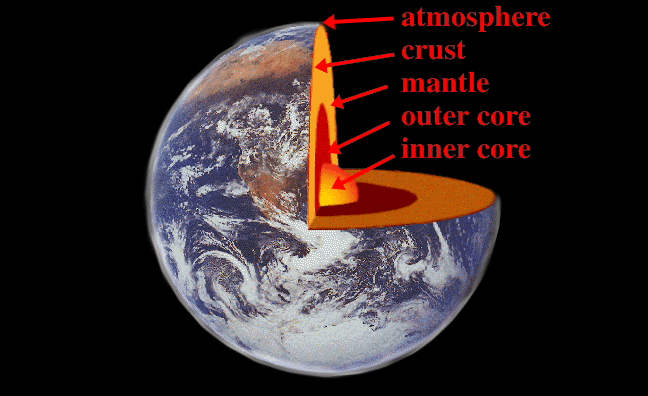
Homework #31 Due October 16 - Layers of the Earth

Name:_________________________________________________________________
Date:________________________________________________________________
Homework #31 - Science - Layers of the Earth

Make Two Short Videos

Dear student, ask a friend, an adult or one of your parents to film you and your explanation about Rock Types and the Earth’s layers. Use A4 paper to make mini posters, make drawings or simply print out images. Use some posts and your notebook notes to help you if needed. Follow the steps and make two short videos:

Video #01 – use mini posters or images to tell about Types of Rocks. Include information about Rock Formation and Rock Cycle (2 - 5 minutes).

Video #02 - Layers of the Earth: what layers are made of, and how each of the layers can be divided (2 - 5 minutes).

On the due day, bring and hand in the two videos for teacher’s check.


     Earth can be divided into three main layers. The layers are the core, the mantle and the crust. Below the mantle is the core, which is the very center of the Earth, Each of these layers can be divided into two parts. For example, the core can be divided into inner and outer core, the mantle into upper and lower mantle, and the continental and oceanic crust. Both the inner and outer core are made up of mostly iron and a little bit of nickel. The Earth is like a giant cake.

Types of Rock

The three main types, or classes, of rock are sedimentarymetamorphic, and igneous and the differences among them have to do with how they are formed. Sedimentary rocks are formed from particles of sand, shells, pebbles, and other fragments of material. Together, all these particles are called sediment...


Monday, October 2, 2017

Homework #30 Due October 9

Name: ______________________________________________________
Date: ______________________________________________________

Homework #30 - Sequence of Events and Personal Response to:

______________________________________________________

Together in class, we did sequence of events and Personal Response to:
Charlotte's Web (An Explosion)  and Pippi Longstocking (Pippi Goes to the Circus). You cannot do your homework about the chapters we did in class. Choose another chapter from the list (image).

Dear student, you saw examples of what you must do about the literature circle book chapter your teacher assigned to you. As an example, we checked Chapter 7 – Pippi Goes to the Circus – Sequence of Events + Personal Response to this book chapter. Remember, your job is to do and follow the same procedures to one of the chapters we read from September 25 to October 2. How can you do it? First write the title of the book chapter on your agenda, secondly identify (write) the sequence of events. Last, write your personal response to what you read in the book chapter. See the example again if needed.

Chapter 7 – Pippi Goes to the Circus – Sequence of Events
            1-    Annika and Tommy invite Pippi to go see a circus that's come to town.
2-    Pippi doesn't know what a "surkus" is, but wants to get a look at one and agrees to go.
3-    Because Pippi pays for her ticket with a genuine gold piece and refuses to accept any change, the ticket lady upgrades all of the children's tickets so they are seated in the grandstand (lovely red chairs right next to the ring).
4-    The first act features ten white horses, and when one stops right in front of the children, Pippi shakes hands and (Pippi offers it greetings from her horse at home).
5-    The second act features a lady riding a black horse, and when they ride past the kids, Pippi hops onto the horse with the lady, Miss Carmencita.
6-    The audience loves Pippi's performance, but neither Miss Carmencita nor the ringmaster are amused.
7-    Two guards try to throw Pippi out, but give up when they are unable to budge her.
8-    The tightrope walker is the next act, and Pippi joins in on that one as well.
9-    The ringmaster wants Pippi gone, but the crowd cheers for her and demands he let her stay.
10-  He attempts to sabotage her by undoing the tightrope wire, but Pippi just swings around for a while and then lands on the ringmaster before returning to her seat.
11-  Next the ringmaster introduces the circus strongman, the Mighty Adolf, and offers one hundred dollars to anyone who can beat him in a wrestling match.
12-  You can guess who takes him on. Pippi accept the challenge and wins. She beats the strong man.
13-  When the ringmaster attempts to give Pippi a one hundred dollar bill, Pippi tells him she has no use for an old piece of paper and suggests he use it to fry some fish.
14-  Last but not least, after that all, Pippi goes back to her seat and takes a nap in the circus.
Personal Response
Dear student, your personal response to any text, topic or story is, for example, a piece of writing by demonstrating a perceptive personal understanding of a text. You need to describe the topic, express your feelings and findings, and give some of your thoughts and ideas about what you read, learned etc. In short, a personal response is (your response) what we did about Pippi Longstocking in our classes. See the following and last exercise we did last week at school.
Chapter 7 – Pippi Goes to the Circus


Description


In this chapter, (Pippi Goes to the Circus) Annika and Tommy invite Pippi to go see a circus that has come to town and Pippi doesn't know what it is. Tommy and Annika explain it to her. However, when Pippi pays for her ticket with gold pieces she doesn’t understand why she needs to pay for it, and she refuses to accept the change. Because of that, the ticket lady gives the three kids special tickets so they get the chance to sit at the grandstand, a much better place to see the act features.


Feelings


I feel sorry for Pippi. She is 9 years old and she has no idea what a circus is. But I felt so happy when the ticket lady upgrades all of the children's tickets so they could be seated in the grandstand. Pippi was very lucky to have the chance and sit on lovely comfortable chairs and stay right next to the ring.


Findings


I didn’t know there were horses in the circus, I believed there were only elephants, monkeys, and lions, but not horses. At first, I didn’t understand Miss Carmencita didn’t like Pippi performing with her. Then after reading a bit more I found not only the ringmaster was angry. Pippi was having fun, but people from the circus didn’t like when she joined in on circus act features. It means that we need to ask for permissions before we do somethings we would like to.


Thoughts and Ideas


In my opinion, even though she got herself into trouble, Pippi had an awesome time, and it was her first awesome time in the circus. It was definitely a great day for her. When the first act features began, the ten white horses stopped right in front of Pippi. I think it was very funny when Pippi offered greetings from her horse to the circus horses. After all the fun moments, though, I didn’t get why Pippi went back to her seat and took a nap in the circus.

Improve your personal responses - What is making an inference in reading?

Making an inference involves using what you know to make a guess about what you don't know, or reading between the lines. Readers who make inferences use the clues in the text along with their own experiences to help them figure out what is not directly said, making the text personal and memorable.


CHARLOTTE’S WEB Page 41


Read the following passage about first impressions from page 41. 


Charlotte stood quietly over the fly, preparing to eat it. Wilbur lay down and closed his eyes. He was tired from his wakeful night and from the excitement of meeting someone for the first time. A breeze brought him the smell of clover—the sweet-smelling world beyond his fence. “Well,” he thought, “I’ve got a new friend, all right! But what a gamble friendship is! Charlotte is fierce, brutal, scheming, bloodthirsty—everything I don’t like. How can I learn to like her, even though she is pretty and, of course, clever?” Wilbur was merely suffering the doubts and fears that often go with finding a new friend. In good time he was to discover that he was mistaken about Charlotte. Underneath her rather bold and cruel exterior, she had a kind heart, and she was to prove loyal and true to the very end. 

Let's Discuss the passage. Consider the questions:

• Did you ever have an experience like this, in which you thought of a person as mean or strange or scary at first, but later found out that he or she was very nice? 
• Can you learn to like someone you originally disliked? How? 
• What do you think the speaker means by “What a gamble friendship is!” (p. 41)? How can friendship be a gamble? 
• What happens when people draw conclusions based on first impressions?

What Is an Equivalent Fraction?

      Equivalent fractions are fractions that look different but show exactly the same amount. If a pie is cut into 4 pieces, then two pieces represent the same amount of pie that1/2 did. We say that 1/2 is equivalent to 2/4; and drawings can help us visualize and understand fractions more easily. Fractions are determined to be equivalent by multiplying the numerator and denominator of one fraction by the same number. You can make equivalent fractions by multiplying or dividing the numerator and denominator by the same number. You can simplify fractions by dividing the numerator and denominator by the same number. This is called cancelling.

Topic sentence and concluding sentences in yellow and detail sentences in different colors.


Drawings can help us visualize and understand fractions more easily.

 Drawings can help us visualize and understand fractions more easily.
Drawings can help us visualize and understand fractions more easily.

Drawings can help us visualize and understand fractions more easily.

Drawings can help us visualize and understand fractions more easily.

Drawings can help us visualize and understand fractions more easily.